VAT Number Check by Company Name: How to Find and Verify Any UK Business

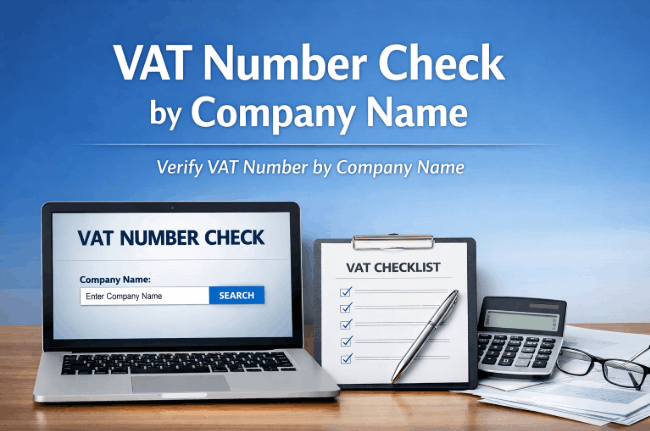
A VAT number check by company name is not directly possible through HMRC’s official checker, the tool requires a VAT number as its input, not a business name. Verifying a UK company’s VAT registration means sourcing the number first, from an invoice, the business’s website, or direct contact, before checking it against HMRC’s service at gov.uk.
Key Takeaways
- HMRC’s official VAT checker at gov.uk validates VAT numbers, it does not support name-based searches
- The VAT register is not a publicly searchable directory; no free tool can confirm VAT registration status using only a company name
- UK VAT numbers are nine digits long, prefixed with GB, for example, GB123456789.
- Businesses with taxable turnover below the current registration threshold are not required to register for VAT and will have no VAT number to provide
What Is a VAT Number and What Does It Look Like?
A UK VAT number is a nine-digit identifier, prefixed with GB, issued by HMRC when a business successfully registers for VAT. It is distinct from a Companies House registration number, which is a separate identifier used solely for company incorporation records.
VAT numbers appear on invoices, receipts, official correspondence, and in the footer of a business’s website. The standard UK format is GB followed by nine digits, for example, GB123456789. Northern Ireland businesses operating under the Northern Ireland Protocol use the prefix XI rather than GB for cross-border EU trade purposes.
A company’s VAT number and its Companies House registration number are not interchangeable. One is issued by HMRC for tax purposes; the other is issued by Companies House for company law purposes. Confusing the two is one of the most common mistakes made when attempting to verify a supplier’s VAT status.
Why HMRC’s VAT Checker Cannot Search by Company Name?
HMRC’s official VAT checker does not support name-based searches, and this is by design, not an oversight. The tool at gov.uk accepts a VAT registration number as its only input. Searching by name alone returns nothing, the function simply does not exist.
The VAT register is not a public directory. HMRC administers it as a confidential tax record. Publishing a name-searchable register would expose commercially sensitive registration data and create significant fraud and impersonation risks. The restriction is deliberate, protecting both businesses and the integrity of the tax system, as governed by the Value Added Tax Act 1994.
This misunderstanding produces three predictable errors. First, many users assume Companies House holds VAT registration data, it does not.
Second, some third-party tools claim to find VAT numbers by company name; in reality, these tools can only validate a number’s format, not confirm its registration status with HMRC.
Third, the absence of a VAT number does not automatically indicate fraud, a business with taxable turnover below the current registration threshold has no obligation to register and will hold no VAT number.
HMRC’s VAT checker requires a valid VAT registration number as input. It cannot search by business name. No publicly available tool or database supports name-only VAT verification in the UK. To confirm a supplier’s VAT status, the VAT number must be obtained first, then checked against HMRC’s official service at gov.uk.

How to Find a Company’s VAT Number by Name: Step by Step
When only a company name is known, the VAT number must be tracked down before any verification is possible. Follow these steps in order.
- Step 1: Check any invoices or receipts from the business. VAT-registered businesses are legally required to display their VAT number on all VAT invoices. Look in the header or footer of any invoice received. It will typically be labelled VAT Reg No, VAT Number, or VAT Registration Number.
- Step 2: Search the company’s website. Most VAT-registered businesses display their VAT number in the website footer, on a legal or terms page, or within a contact or about section. Search the footer first, this is the most common placement.
- Step 3: Contact the business directly. Any legitimate VAT-registered business is legally permitted to share its VAT number. Request it by email or telephone. A business that refuses to share it when asked directly is worth treating with caution before any VAT payment goes through.
- Step 4: Cross-reference with Companies House. Companies House does not hold VAT numbers, but its free search tool confirms a business’s legal identity, registered address, and incorporation status. Find it at find-and-update.company-information.service.gov.uk. Use this to verify you are dealing with a legitimately incorporated entity before pursuing VAT verification.
- Step 5: Validate the number using HMRC’s official checker. Once the VAT number has been obtained, go to gov.uk/check-uk-vat-number and enter it. The tool confirms validity and returns the registered business name and address. Ensure these match the supplier you are dealing with.
- Step 6: Contact the HMRC VAT helpline as a last resort. If the number cannot be obtained through any of the above routes, HMRC’s VAT helpline can assist in limited circumstances. Be prepared to provide a reason for the enquiry. HMRC will not confirm or deny VAT registration for a named business without the VAT number in most cases.
How to Check If a Company Is VAT Registered Without a VAT Number?
If no VAT number is available, there is no direct route to confirming VAT registration status, the HMRC checker requires the number as its input, and no public name-to-registration lookup exists in the UK.
The only reliable approach is to obtain the number first. Check invoices, the company’s website footer, terms pages, and official correspondence. Contact the business directly if those sources yield nothing. Any legitimately registered business will share its VAT number on request, persistent refusal is a red flag, not standard practice.
If a supplier is charging VAT on invoices but cannot or will not provide a valid VAT number, do not pay the VAT element. Paying VAT to an unregistered business means it cannot be reclaimed as input tax, that cost sits with you, not HMRC.
Staying across business compliance obligations more broadly, including employment rules such as how many hours between shifts, reduces the risk of overlooked liabilities across your operation.
If deliberate VAT fraud is suspected, such as a business consistently charging VAT with no valid registration, report it to HMRC’s fraud hotline. This is distinct from a supplier simply being below the registration threshold, which carries no fraudulent intent and no obligation to charge VAT at all.

Does Companies House Tell You If a Company Is VAT Registered?
Companies House does not hold, display, or share VAT registration information, the two registers are entirely separate.
Companies House displays the registered company number, registered office address, SIC code, directors, persons of significant control, confirmation statements, and filed accounts. VAT registration status does not appear in any of them, it falls under HMRC’s remit, not Companies House’s.
The separation exists because the two bodies serve different legal functions. Companies House administers the Companies Act 2006. HMRC administers the Value Added Tax Act 1994. A business can be incorporated at Companies House without ever registering for VAT, and many legitimately are.
Conversely, sole traders and partnerships can be VAT-registered without any Companies House record at all.
When verifying a supplier’s VAT status, Companies House is a useful tool for confirming legal identity, but it is not a route to VAT verification. That route runs exclusively through HMRC.
VAT Number Checks: Myth vs Reality
| Myth | Reality |
|---|---|
| You can search HMRC's VAT checker by company name | False. The checker accepts VAT numbers only; name search is not supported |
| Companies House shows whether a business is VAT registered | False, VAT data is held exclusively by HMRC; Companies House holds no VAT records |
| Every limited company has a VAT number | False. Only companies registered for VAT hold one; registration is mandatory only above the taxable turnover threshold |
| A missing VAT number on an invoice automatically means fraud | Not necessarily. The supplier may be legitimately below the registration threshold and is not permitted to charge VAT |
| Third-party VAT checker tools can find a number by company name | False. These tools validate a number's format and check it against VIES; they cannot search by name or confirm HMRC registration |
| VIES can verify mainland UK VAT numbers | False. Post-Brexit, VIES covers Northern Ireland (XI prefix) only; GB-prefixed numbers must be verified via HMRC |
| A VAT number, once issued, never changes | Mostly true. But businesses that deregister and later re-register may receive a new number |
How to Use the HMRC VAT Checker Once You Have the Number?
The HMRC VAT checker at gov.uk/check-uk-vat-number is the definitive tool for confirming UK VAT registration status. It is free to use and requires no account or login.
- Step 1: Go to gov.uk/check-uk-vat-number.
- Step 2: Enter the VAT number in the format shown, nine digits, with or without the GB prefix. The tool accepts both formats.
- Step 3: The result confirms whether the number is valid and returns the registered business name and address. Check that the registered name and address match the business on your invoice. A mismatch, such as a different company name appearing against the number, should be investigated before any VAT payment is made.
- Step 4 (optional): If you are VAT-registered yourself, enter your own VAT number when prompted. The tool then generates a timestamped record of the check. HMRC accepts this as evidence of due diligence if your VAT reclaim is ever queried during an audit.
The HMRC VAT checker at gov.uk/check-uk-vat-number confirms whether a UK VAT number is valid, returns the registered business name and address, and, for VAT-registered users, generates a timestamped verification record. It is free, requires no login, and produces results instantly.
VAT Verification Tools: Which to Use and When
| Tool | Best For | What It Confirms | Cost | Key Limitation |
|---|---|---|---|---|
| HMRC VAT Checker (gov.uk) | All UK VAT verification | Validity, registered name, registered address | Free | Requires VAT number, no name search |
| VIES (Europa.eu) | Northern Ireland (XI) and EU supplier checks | EU VAT validity and registered details | Free | Does not cover mainland GB (GB prefix) |
| HMRC VAT Helpline | Cases where online check is inconclusive | Limited confirmation in specific circumstances | Free | May require justification; not a first resort |
| Company invoice or website | Sourcing the VAT number before verification | Provides the number for subsequent HMRC check | Free | Relies on supplier accuracy; requires follow-up check |
What to Do When a VAT Number Returns No Valid Result?
An invalid result from HMRC’s checker rarely means fraud, several legitimate explanations exist. Several legitimate explanations exist before that conclusion should be reached.
- Check for a transcription error. VAT numbers on invoices are sometimes mistyped. Verify the number character by character against the source document.
- The business may have recently deregistered. A business whose taxable turnover dropped below the deregistration threshold (currently £88,000) may have cancelled its VAT registration, either by choice or obligation. Deregistered businesses must stop charging VAT immediately.
- The business may be newly registered. HMRC’s system can take a short period to update after a new registration is processed. Ask the supplier for their VAT registration certificate as interim confirmation.
- Contact the supplier to reconfirm the number. Request a corrected VAT invoice if a discrepancy exists.
- Escalate to HMRC if VAT is being charged without a valid number. If a supplier is consistently charging VAT and the number fails every check, report it to HMRC’s fraud hotline. Do not pay the VAT element until a valid number is confirmed.
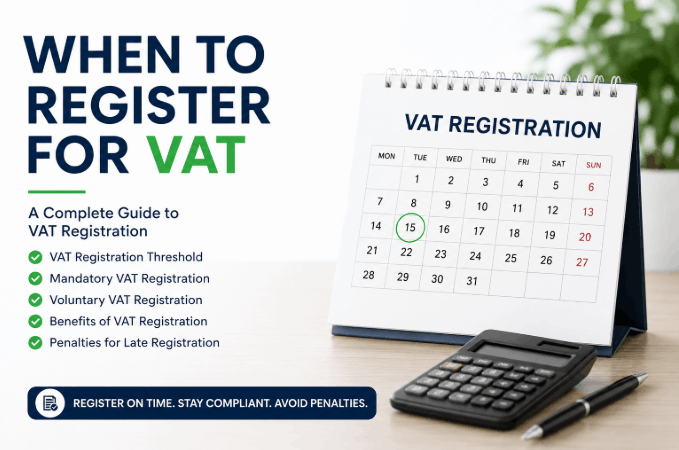
According to HMRC, only businesses with a taxable turnover exceeding £90,000 in a rolling 12-month period are required to register for VAT. A business below this threshold is not permitted to charge VAT on sales, and any business doing so without valid registration is acting unlawfully.
Conclusion
A VAT number check by company name begins not with HMRC’s checker, but with sourcing the number first, from an invoice, a website footer, or direct contact with the business. Once obtained, the HMRC checker at gov.uk/check-uk-vat-number confirms validity, registered name, and address in seconds.
Third-party tools are sometimes presented as a name-based alternative, but they are not. No tool, free or paid, can confirm HMRC registration status without a VAT number as input.
A VAT number check by company name means obtaining the number through available business documentation first, then verifying it through HMRC, for every UK business in 2025–26.
Information verified against HMRC guidance. Check gov.uk for the most current VAT registration thresholds and checker service availability.
FAQ
Can I find a VAT number using just a company name?
No. There is no publicly available database in the UK that allows VAT number lookup by company name alone. HMRC does not publish a name-searchable VAT register. To find a company’s VAT number, check their invoices, website footer, or contact them directly. Only after obtaining the number can it be verified through HMRC’s official checker.
Is the HMRC VAT checker free to use?
Yes. The HMRC VAT checker at gov.uk/check-uk-vat-number is entirely free and requires no registration or login. VAT-registered businesses can also use it to generate a timestamped record of their checks, which serves as audit evidence if HMRC queries a VAT reclaim at a later date.
Does every limited company have a VAT number?
No. A limited company only holds a VAT number if it has registered for VAT with HMRC. Registration is compulsory only when taxable turnover exceeds £90,000 in any rolling 12-month period. Businesses below this threshold are not required to register, though voluntary registration is permitted and sometimes commercially advantageous.
What format is a UK VAT number?
A UK VAT number consists of nine digits prefixed with GB, for example, GB123456789. Northern Ireland businesses trading with EU member states use the prefix XI instead of GB. The VAT number is separate from a company’s Companies House registration number, which is shorter and formatted differently.
Can a business charge VAT without being registered?
No. Charging VAT without a valid VAT registration number is a criminal offence under UK law. Only VAT-registered businesses are permitted to add VAT to their sales and issue VAT invoices. If a supplier charges VAT but cannot provide a valid registration number that passes the HMRC checker, do not pay the VAT element and consider reporting it to HMRC.
How do I report a business charging VAT fraudulently?
Report suspected VAT fraud to HMRC online via the tax evasion reporting form at gov.uk, or by calling the HMRC fraud hotline. Provide the business name, address, and any invoice details. HMRC treats VAT fraud reports confidentially. Paying VAT to a fraudulently unregistered business means you cannot reclaim that VAT as input tax, HMRC will not reimburse it.
What is the current VAT registration threshold in the UK?
The VAT registration threshold is £90,000 of taxable turnover in any rolling 12-month period, as of the 2024–25 tax year. Businesses that exceed this threshold must register within 30 days of the point at which they become liable. Check gov.uk/vat-registration-thresholds for the most current figure, as the threshold is subject to change in each Budget.
Disclaimer: This article is for informational purposes only and does not constitute tax, legal, or financial advice; always verify current VAT registration details directly with HMRC at gov.uk.