How to Master Companies House Search: Step-by-Step Guide to Free Company Data and Director Verification

A Companies House search is free public access to the UK’s official company register, maintained by Companies House as an executive agency of the Department for Business and Trade. Using the Find and Update Company Information service, anyone can retrieve registered data on over five million active UK entities, no account, no fee, and no registration required.
Key Takeaways
- A Companies House search is entirely free, all basic company records, including officer details, filing history, and the PSC register, are publicly accessible without creating an account.
- Since 18 November 2025, every officer record returned by a Companies House search includes an identity verification status field, introduced under the Economic Crime and Corporate Transparency Act 2023.
- The director search function returns all current and former directorships linked to an individual, including appointment dates and service addresses across every registered entity.
- Dissolved company records remain searchable through Companies House for 20 years after dissolution before transfer to The National Archives.
What Is a Companies House Search?
A Companies House search is the publicly accessible search function of the UK’s official company register, a single, free entry point into the records of every limited company, limited liability partnership, and public limited company incorporated in England, Wales, Scotland, or Northern Ireland.
Companies House operates as an executive agency of the Department for Business and Trade. Its duty under the Companies Act 2006 is to receive, store, and make publicly available the statutory information that registered entities are legally required to file.
That register currently holds records on over five million active entities, with more than 800,000 new incorporations processed in 2024/25 alone.
The register is split across three jurisdictional registrars: Companies House Cardiff covers England and Wales, Companies House Edinburgh covers Scotland, and Companies House Belfast covers Northern Ireland.
A single search through the Find and Update Company Information service queries all three simultaneously, the jurisdictional split is invisible to the user.
Every search result reflects what companies are legally required to report. That is the register’s greatest strength and its clearest limitation.
What Information Does a Companies House Search Return?
A companies house search returns seven core data categories, all free to access, all publicly visible without registration.
The following information is available for every registered entity:
- Company name and company registration number (CRN): The unique identifier assigned at incorporation; the most reliable way to confirm a specific entity when common names produce multiple results.
- Registered office address: The official address for legal correspondence; this is not necessarily a trading address.
- Incorporation date and SIC code: The date the company was formally registered and the Standard Industrial Classification code indicating its declared business activity.
- Officer records: Names, appointment dates, service addresses, and resignation dates for all current and former directors and company secretaries. Since 18 November 2025, each record also shows an identity verification status field.
- Filing history: Every document submitted to Companies House, including annual accounts, confirmation statements, and director change notices, available to download.
- Persons with Significant Control (PSC) register: Names and the nature of control (shareholding percentage, voting rights, or other significant influence) for all registrable PSCs; fully public and free to access.
- Mortgage and charge data: Details of any charges registered against the company’s assets.
One limitation requires a clear explanation: shareholder information is not returned directly in search results. Shareholder data is contained within confirmation statement documents, which must be individually downloaded from the filing history.
Users expecting to see a live shareholder breakdown in the main search result will not find one. The data exists, but accessing it requires an extra step.
Additionally, if you are looking into a company’s tax details, remember that Companies House handles corporate structure, not tax registration.
For instance, if you need to verify a business’s tax status, you will need to run a separate VAT number check by company name through HMRC’s databases, as this data is kept entirely separate from the public registry.
The Find and Update Company Information service also allows free email alerts, notifying registered users when a specific company updates its details. Setting up alerts requires a GOV.UK One Login account, viewing records does not.

How to Use Companies House Search: Three Methods
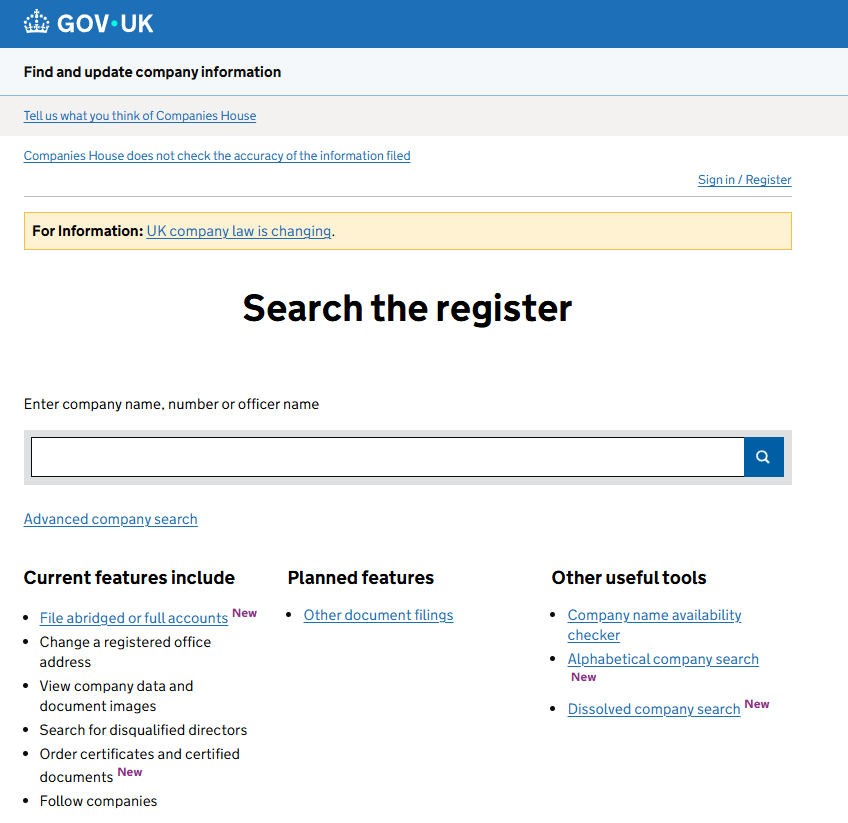
Three search methods are available through the Find and Update Company Information service, all accessible from the same search bar at find-and-update.company-information.service.gov.uk.
- Search by company name: Type the registered company name into the search bar. For common names, the results page will return multiple matches; use the registered office address or incorporation date shown in each result to identify the correct entity. Partial name searches are supported.
- Search by company registration number (CRN): Enter the unique eight-character CRN directly. This is the fastest and most precise method. Every UK company has a unique CRN assigned at incorporation, it appears on all official company correspondence and filings. There is no ambiguity in a CRN search.
- Search by officer name: Enter a director’s or company secretary’s name to return all current and former directorships linked to that individual across every registered entity. This method is particularly useful when due diligence requires assessing how many companies a specific person controls or has previously been involved with.
Widely circulated claim: Companies House operates under the Department for Business, Energy & Industrial Strategy, and some company information requires a login to access.
Correct position – department name: Companies House is an executive agency of the Department for Business and Trade. The Department for Business, Energy & Industrial Strategy was dissolved in February 2023 following machinery-of-government changes. Several ranking competitor articles continue to use the old name, it is incorrect.
Correct position – login requirement: No login or registration is required to search for or view any basic company record, including officer details, filing history, accounts, and PSC data. A GOV.UK One Login account is required only for filing documents or setting up email alerts, not for searching.
If you are a business owner looking to submit filings yourself, you’ll manage this through your official Government Gateway credentials, rather than the public-facing search portal.

Companies House Advanced Search: Filters and What They Do
Advanced search extends the standard Companies House search with four filter parameters, enabling targeted queries that a name or number search alone cannot achieve.
The four filters available through the advanced search function are:
- Company status: Filter results to show only active companies, dissolved companies, companies in administration, or those in the process of being struck off.
- Company type: Narrow results by legal structure: private limited company, public limited company, limited liability partnership, limited by guarantee, and others.
- SIC code: Search for all registered companies operating under a specific Standard Industrial Classification code, useful for sector-level research or competitive mapping.
- Incorporation date range: Set a start and end date to surface companies incorporated within a specific window, useful for identifying recent entrants to a market.
Advanced search adds the most value when a name search returns too many results to assess manually, when sector-specific research is the goal, or when confirming whether a recently cited company name matches an active registration.
For straightforward verification of a known company, the standard name or CRN search remains faster.
Companies House Director Search: How to Find Officer Records?
A Companies House director search returns every current and former directorship linked to an individual, including appointment dates, service addresses, and, since 18 November 2025, identity verification status, across all registered entities simultaneously.
What the Director Record Shows
Each officer record returned by a director search displays: the individual’s name, their service address (which may differ from their home address, a service address is a legal correspondence address only), appointment date, resignation date where applicable, date of birth shown as month and year only (the day is withheld from the public register), nationality, and occupation as declared at the time of appointment.
Reviewing how many companies a director is currently appointed to, and whether any of those companies are dissolved or in administration, is a standard due diligence check that takes under two minutes using the officer search function.
Disqualified Directors
A companies house director search does not show disqualification status. Disqualification records are held on a separate register maintained by the Insolvency Service, the Register of Disqualified Company Directors.
Checking this register requires a separate search at gov.uk/search-the-register-of-disqualified-company-directors. Any due diligence process that relies solely on a Companies House director search without checking the Insolvency Service register is incomplete.

The New IDV Status Field: What It Means When You Search
Since 18 November 2025, every officer record returned by a Companies House search includes an identity verification status field, the most significant change to what search results actually display in over a decade.
The field is a direct consequence of the Economic Crime and Corporate Transparency Act 2023, which introduced mandatory identity verification for all company directors, secretaries, and Persons with Significant Control.
The purpose is to reduce the abuse of the register by individuals using false identities to incorporate companies for fraudulent purposes.
Three statuses are possible on any officer record:
- Verified: The individual has completed identity verification, either directly through GOV.UK One Login or through an Authorised Corporate Service Provider (ACSP).
- Not yet verified: The individual has not yet completed verification. This does not automatically indicate a problem.
- Exempt: The individual falls within a category exempt from the requirement under ECCTA provisions.
The critical distinction for anyone using the director search for due diligence is context.
An unverified status on a director of a company incorporated before November 2025 does not warrant the same concern as an unverified status on a director of a company incorporated after that date, for whom verification was a requirement from the point of incorporation.
The rollout deadline for existing officers extends through 2026 under the ACSP schedule, meaning a significant proportion of long-standing directors will carry an unverified status during the transition period.
The most widespread misunderstanding about IDV is that it applies only to new incorporations. It applies to all existing directors and PSCs across the entire register.
The difference is timing, new appointees must verify before their appointment is processed, and existing officers have a phased deadline.
Under the Economic Crime and Corporate Transparency Act 2023, identity verification became mandatory for all UK company directors and PSCs from 18 November 2025.
A Companies House search now shows each officer’s IDV status, verified, not yet verified, or exempt, directly within their record. The rollout deadline for existing officers extends through 2026.

What Companies House Search Cannot Tell You
A companies house search returns official registered data only. Several categories of information that users commonly expect to find are either absent from the register entirely or held elsewhere.
| Available via Companies House Search | Not Available via Companies House Search |
|---|---|
| Registered office address | Trading or operational address |
| Officer names and appointment dates | Personal home addresses of directors |
| Filing history and annual accounts | HMRC tax status or VAT registration number |
| PSC register (beneficial ownership) | Credit score or payment behaviour |
| Incorporation date and SIC code | Sole trader or partnership records |
| Mortgage and charge data | Charity Commission registrations |
| Dissolved company records (up to 20 years) | Records older than 20 years (held by The National Archives) |
| Company status (active, dissolved, in administration) | Disqualification status (held by the Insolvency Service) |
Two limitations produce the most frequent user confusion. First, charities registered solely with the Charity Commission, and not separately incorporated as a company limited by guarantee, do not appear in Companies House search results at all.
Searching for a charity by name and finding no result does not mean the charity does not exist; it may simply not be registered under the Companies Act 2006. Second, dissolved company records are searchable through Companies House for 20 years after dissolution.
After that point, records are transferred to The National Archives and are no longer accessible via the standard search interface.
Using Companies House Search to Check Company Legitimacy
A Companies House search is one of the most reliable free tools available for verifying whether a UK business is legitimate. Five checks, run in sequence, produce a defensible assessment of any registered entity.
- Confirm active status and name match: Verify the company is registered as active and that the registered name matches exactly what the business has presented to you. A dissolved status, a name under administration, or a slight discrepancy in the registered name are immediate flags requiring explanation.
- Verify the registered office address: Cross-reference the registered office address shown on Companies House against the address the company has provided in its communications. A significant mismatch, particularly a registered office that is a mass-formation agent address for a company claiming to be an established business, warrants closer scrutiny.
- Assess officer records and appointment history: Check how long current directors have been appointed. Review whether any directors have a pattern of multiple dissolved companies on their record. A single dissolved company is unremarkable; a sequence of dissolved companies in the same sector is a legitimate due diligence concern.
- Review filing history for compliance: Confirm that confirmation statements and annual accounts are being filed on time. Persistent late filings or gaps in the filing history indicate a company not meeting its statutory obligations, a relevant signal for any party considering entering a commercial relationship.
- Check the PSC register: Confirm that beneficial ownership is declared and that the persons listed match what the company has represented to you. An absence of PSC entries on an active company is a statutory non-compliance issue and should be treated as a red flag.
To check if a UK company is legitimate using Companies House, confirm the company is active, verify the registered office address matches what the business has provided, check officer appointment history for dissolved company patterns, review filing compliance, and cross-reference the PSC register against declared beneficial ownership. All five checks are free.

Conclusion
A Companies House search gives anyone in the UK free, immediate access to the official public record of over five million registered entities, no cost, no account, and no barriers to the core data. For due diligence, supplier verification, or straightforward fact-checking, the register remains the first and most authoritative source to consult.
A Companies House search means verified, official company data at no cost for anyone transacting in the UK economy in 2026.
FAQ
Is a Companies House search free?
Yes. All basic company records, including registered office address, officer details, filing history, annual accounts, and the PSC register, are publicly accessible at no cost and without registration. A GOV.UK One Login account is required only for filing documents or receiving email alerts, not for searching or viewing any record.
Does Companies House show shareholders?
Not directly. Shareholder information is not displayed in the main search result. It is contained within confirmation statement documents, which are available to download free of charge from the company’s filing history. Each confirmation statement lists the company’s shareholders at the time of filing.
Can you search for dissolved companies on Companies House?
Yes. Dissolved company records remain fully searchable through the Find and Update Company Information service for 20 years after the dissolution date. After 20 years, records are transferred to The National Archives and are no longer accessible via the standard Companies House search interface.
How do I search for a director on Companies House?
Enter the director’s name into the search bar at find-and-update.company-information.service.gov.uk and select the officer search option. Results return all current and former directorships linked to that name. To check whether a director has been disqualified, a separate search of the Insolvency Service’s Register of Disqualified Company Directors is required, disqualification status does not appear in Companies House director search results.
What has changed at Companies House since 2025?
The most significant change is the introduction of mandatory identity verification under the Economic Crime and Corporate Transparency Act 2023, which took effect on 18 November 2025. Every officer record in a companies house search now displays an IDV status field. The Companies House advanced search interface has also been updated to reflect new company type categories introduced under ECCTA, including Authorised Corporate Service Providers.
Disclaimer: The information provided in this article is for general informational and educational purposes only and does not constitute formal legal, financial, or professional tax advice; readers are strongly encouraged to seek independent professional counsel before acting on any registry data or corporate insights detailed herein.