50k After Tax UK: Comprehensive Guide to Breakdown Net Pay, Tax Rates, Pension Savings, and Student Loans

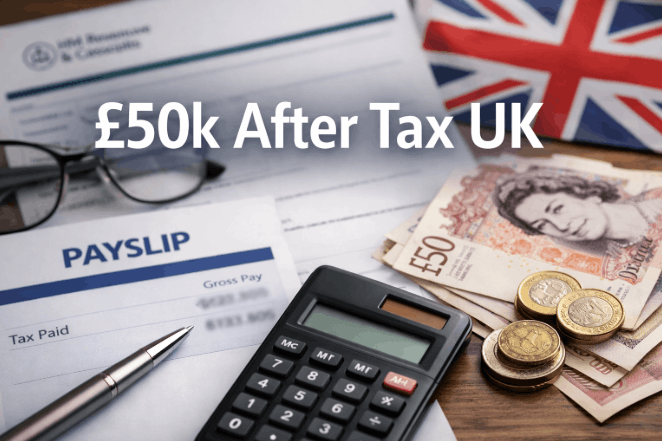
On a £50,000 gross salary, take-home pay in the UK is £39,519.60 per year in 2025/26, £3,293.30 per month, £759.99 per week, and £152 per day. Income tax of £7,486 and National Insurance of £2,994.40 produce a combined deduction of £10,480.40 and an effective rate of 20.96%.
Figures reflect HMRC tax code 1257L, applying to England, Wales, and Northern Ireland.
Key Takeaways
- The 50k after tax UK take-home figure is £39,519.60 per year in 2025/26, after income tax of £7,486, and National Insurance of £2,994.40 are deducted by HMRC via the PAYE system.
- Scottish taxpayers receive approximately £38,200 in annual take-home pay on a £50,000 gross salary, around £1,320 less per year than equivalent earners in England, Wales, or Northern Ireland.
- Salary sacrifice pension contributions, student loan plan type, and employer National Insurance obligations each materially shift the real cost and take-home value of a £50,000 salary.
What Does £50,000 Take Home After Tax in the UK?
The 50k after tax UK take-home pay is £39,519.60 per year under 2025/26 HMRC rates, after income tax and National Insurance are deducted via PAYE. The Personal Allowance of £12,570 exempts the first portion of earnings from tax, leaving £37,430 in taxable income subject to the 20% basic rate.
For 2026/27, the Personal Allowance and higher-rate threshold are confirmed at identical levels, the take-home figure on a £50,000 salary remains £39,519.60.
| Annual | Monthly | Weekly | Daily | Hourly | |
|---|---|---|---|---|---|
| Gross Salary | £50,000.00 | £4,166.67 | £961.54 | £192.31 | £24.04 |
| Income Tax | −£7,486.00 | −£623.83 | −£143.96 | −£28.79 | −£3.60 |
| National Insurance | −£2,994.40 | −£249.53 | −£57.58 | −£11.52 | −£1.44 |
| Take-Home Pay | £39,519.60 | £3,293.30 | £759.99 | £152.00 | £19.00 |
Standard tax code 1257L. Figures confirmed as of April 2025 via HMRC’s published 2025/26 rates. Applies to England, Wales, and Northern Ireland. No student loan or pension deductions included.
The effective rate of 20.96%, covering both income tax and National Insurance, confirms that a £50,000 earner retains 79% of gross salary after all PAYE deductions.
Where personal deductions differ from these standard assumptions, an HMRC-aligned take-home pay calculator produces a more accurate net figure for individual circumstances.
The mechanics behind the £7,486 income tax bill clarify precisely why the 40% higher rate does not apply at this salary level.

How Income Tax Is Calculated on a £50,000 Salary?
All taxable income on a £50,000 salary falls within the 20% basic rate band, the 40% higher rate does not apply here.
According to HM Revenue & Customs, the Personal Allowance for 2025/26 is £12,570, established under the Income Tax Act 2007 as the amount an individual can earn before income tax becomes payable. The resulting tax bill of £7,486 reflects basic rate taxation on £37,430 of taxable income alone.
The calculation runs in four steps:
- Identify gross salary: £50,000
- Subtract the Personal Allowance: £50,000 − £12,570 = £37,430 in taxable income
- Apply the 20% basic rate: £37,430 × 20% = £7,486 income tax
- HMRC collects via PAYE: the monthly payslip deduction is £623.83, applied consistently across the tax year
The higher-rate threshold stands at £50,270 for 2025/26. A salary of £50,000 sits £270 below that boundary, the 40% rate does not apply to a single pound of earnings at this level.
50k After Tax UK: Common Myth vs Reality
| Myth | Reality |
|---|---|
| A £50k salary is taxed at 40% | The 40% higher rate applies only to income above £50,270; £50,000 sits entirely below that threshold |
| Tax is taken from the full £50,000 | Income tax applies only to the taxable income of £37,430, after the £12,570 Personal Allowance is deducted |
| Income tax and NI combined take 40% of pay | The effective combined rate is 20.96%, and earners retain 79% of their gross salary |
| Take-home pay is uniform across the UK | Scottish taxpayers take home approximately £1,320 less per year than rUK earners at this salary |
The marginal tax rate of 20% and the effective income tax rate of 14.97% are distinct figures at this salary. National Insurance follows a separate framework, and at exactly £50,000, a specific arithmetic detail keeps the bill below what several widely circulated calculators report.

How Much National Insurance Does a £50,000 Earner Pay?
National Insurance on a £50,000 salary totals £2,994.40 under Class 1 Category A rates for 2025/26. Because £50,000 falls below the Upper Earnings Limit of £50,270, the 8% main rate applies to all earnings above the Primary Threshold, the 2% upper rate does not trigger at this salary level.
The precise calculation: (£50,000 − £12,570) × 8% = £37,430 × 8% = £2,994.40. These National Insurance contributions fund the NHS, state pension, and social security under HMRC’s Class 1 employer and employee framework.
Widely circulated figure: £3,016 in National Insurance appears across several salary calculator tools for a £50,000 salary.
Correct position: £2,994.40. The £3,016 figure arises from applying the 8% main rate to the full span up to the Upper Earnings Limit, calculating (£50,270 − £12,570) × 8% = £3,016, rather than to actual earnings of £50,000.
Because the salary sits below the Upper Earnings Limit, NI is correctly calculated on actual earnings only: (£50,000 − £12,570) × 8% = £2,994.40.
Source: HM Revenue & Customs, Class 1 National Insurance rates and thresholds, 2025/26.
Unlike income tax, National Insurance carries no personal allowance taper for earners below £100,000. Salary sacrifice is one of the few mechanisms that simultaneously reduces both the income tax and National Insurance bills in a single step.
How Pension Contributions and Salary Sacrifice Reduce Tax?
Salary sacrifice reduces taxable gross pay before both income tax and National Insurance are calculated, producing a simultaneous saving on two separate deductions.
The Pensions Regulator mandates auto-enrolment contributions for eligible employed earners, but voluntary contributions above the minimum threshold generate meaningful additional relief at a £50,000 salary.
Three contribution scenarios at this income level:
- 5% salary sacrifice (£2,500/year): Taxable gross falls to £47,500. Income tax saving: £500. National Insurance savings: £200. Total annual saving: £700, the full £2,500 enters the pension pot, but the net take-home cost is only £1,800.
- 10% salary sacrifice (£5,000/year): Taxable gross reduces to £45,000. Combined income tax and National Insurance saving: £1,400 per year. Employer auto-enrolment contributions increase total pension growth further.
- 15% salary sacrifice (£7,500/year): Taxable gross drops to £42,500, sitting well clear of the £50,270 higher-rate threshold. Combined annual savings: £2,100.
The High Income Child Benefit Charge threshold was raised to £60,000 for 2025/26, families earning £50,000 are no longer subject to any HICBC clawback.
Pension contributions and student loan repayments operate as separate deductions; their combined effect can shift the final take-home figure by several thousand pounds per year.

Student Loan Repayments on a £50,000 Salary
Student loan deductions reduce take-home pay materially, and the repayment plan type determines the precise amount. A Plan 5 borrower on a £50,000 gross salary repays £2,250 per year via the Student Loans Company, reducing take-home to approximately £37,270 rather than the standard £39,519.60.
| Plan | Who It Applies To | 2025/26 Threshold | Annual Repayment | Take-Home After |
|---|---|---|---|---|
| Plan 1 | Pre-2012 England/Wales starters | £24,990 | £2,250.90 | ~£37,269 |
| Plan 2 | Post-2012 England/Wales starters | £27,295 | £2,043.45 | ~£37,476 |
| Plan 4 | Scottish post-1998 starters | £31,395 | £1,674.45 | ~£37,845 |
| Plan 5 | Post-Aug 2023 English starters | £25,000 | £2,250.00 | ~£37,270 |
| Postgraduate | Master's/doctoral graduates | £21,000 | £1,740.00 | ~£37,780 |
Repayment rate: 9% of income above threshold (6% for Postgraduate loans). Deducted via PAYE alongside income tax and National Insurance. Thresholds confirmed by the Student Loans Company for 2025/26. For uprated 2026/27 thresholds, verify directly with the Student Loans Company.
Plan 5’s £25,000 threshold is the lowest of all active plans, making it the most impactful on net pay at the £50,000 salary level.
The total cost of a £50,000 salary also contains a second figure that never appears on any payslip, one that shapes the employer’s position in every salary discussion.
What a £50,000 salary actually cost an Employer?
The total employment cost of a £50,000 salary is approximately £56,750 per year, a figure absent from every payslip but central to every salary negotiation at this level. Employer National Insurance contributions are charged at 15% on earnings above the secondary threshold of £5,000 for 2025/26.
The employer-side calculation in five steps:
- Employer NI rate for 2025/26: 15%
- Secondary threshold (below which employer NI is not charged): £5,000 per year
- Employer NI: (£50,000 − £5,000) × 15% = £6,750
- Total employment cost: £50,000 + £6,750 = £56,750 per year
- Marginal cost of a £1,000 pay rise: approximately £1,150 once employer National Insurance is factored in
A requested £2,000 gross pay increase, therefore costs the employer approximately £2,300 in total. This 15% premium above the stated gross figure explains why modest salary increases at this level are frequently contested, and why employees who understand the employer’s actual outlay negotiate from a materially stronger position.

£50,000 After Tax in Scotland
A £50,000 gross salary produces approximately £38,200 in annual take-home pay for Scottish taxpayers in 2025/26, around £1,320 less per year than the £39,519.60 figure for England, Wales, and Northern Ireland.
The difference arises from Scotland’s intermediate income tax rate of 21% and a higher rate of 42%, both of which apply at this salary level and are set independently by the Scottish Government.
Scottish income tax bands for 2025/26, set by the Scottish Government and projected annually by the Scottish Fiscal Commission:
- Starter rate (19%): earnings from £12,571 to £15,397
- Basic rate (20%): earnings from £15,398 to £26,561
- Intermediate rate (21%): earnings from £26,562 to £43,662
- Higher rate (42%): earnings above £43,662
At £50,000, Scottish taxpayers incur both the 21% intermediate rate and the 42% higher rate, neither applies to equivalent earners in England, Wales, or Northern Ireland.
The result is a Scottish take-home figure considerably closer to a typical 38k after-tax pay packet south of the border than the £39,519.60 headline suggests.
Is £50,000 a Good Salary in the UK?
£50,000 sits well above the UK median gross annual salary of approximately £37,430 for full-time employees, as recorded by the ONS for 2024. Monthly take-home pay of £3,293.30 supports comfortable living across most UK regions, though in London, housing costs alone can absorb 50–70% of that monthly net income.
The salary also occupies a strategically significant position in the UK tax system. At exactly £50,000, all taxable income falls below the £50,270 higher-rate threshold, any pay rise above that point immediately attracts 40% tax on the incremental earnings rather than 20%.
For comparison, an 80k After Tax UK salary illustrates precisely how the gross-to-net ratio narrows once higher-rate taxation applies at scale.
For mortgage eligibility, lenders typically apply a 4–4.5x gross salary multiplier at this income level, giving a borrowing range of approximately £200,000–£225,000.
The questions below address the most commonly searched points about take-home pay at this salary, including the 40% tax misconception that persists despite being arithmetically straightforward to disprove.

Conclusion
On a 50k after tax UK basis, a £50,000 gross salary delivers £39,519.60 in annual take-home pay, £3,293.30 per month, under 2025/26 HMRC rates applied via PAYE. Scotland, student loan plan type, and salary sacrifice decisions each move that figure by hundreds to thousands of pounds.
FAQ
Do you pay 40% tax on a £50,000 salary?
No. The 40% higher rate applies only to income above £50,270 in the 2025/26 tax year. A salary of exactly £50,000 sits £270 below that boundary, every pound of taxable income is subject to the 20% basic rate only, producing an income tax bill of £7,486.
How much take-home pay does a 50k after tax UK salary produce per month?
Monthly take-home on a 50k after tax UK salary is £3,293.30 under HMRC’s standard PAYE system for 2025/26, assuming tax code 1257L and no additional deductions. The weekly equivalent is £759.99, and the daily rate is £152. For personalised figures, the HMRC take-home pay calculator accounts for individual deductions.
Does a student loan change the take-home figure on £50,000?
Yes, meaningfully. A Plan 5 borrower repays £2,250 per year at this salary, reducing take-home to approximately £37,270. A Plan 2 borrower repays £2,043.45, leaving approximately £37,476. The applicable plan is the determining factor, the comparison table above covers all active plans in full.
Can salary sacrifice at £50,000 eliminate higher-rate tax exposure?
Yes. Any pension salary sacrifice contribution that reduces taxable gross income below £50,270 removes higher-rate tax liability entirely. A 5% contribution of £2,500 per year saves approximately £700 in combined income tax and National Insurance while adding directly to pension wealth.
What is the effective tax rate on a £50,000 salary?
The effective combined rate of income tax and National Insurance on a £50,000 salary is 20.96%. Total deductions are £10,480.40, comprising £7,486 in income tax and £2,994.40 in National Insurance. A £50,000 earner retains 79% of gross salary after all statutory PAYE deductions.
Disclaimer: This article is for informational purposes only and does not constitute professional financial or tax advice; always verify your specific circumstances with HMRC or a qualified financial advisor.