UK DIY Retailer Administration: What Happened, What It Means, and What Comes Next

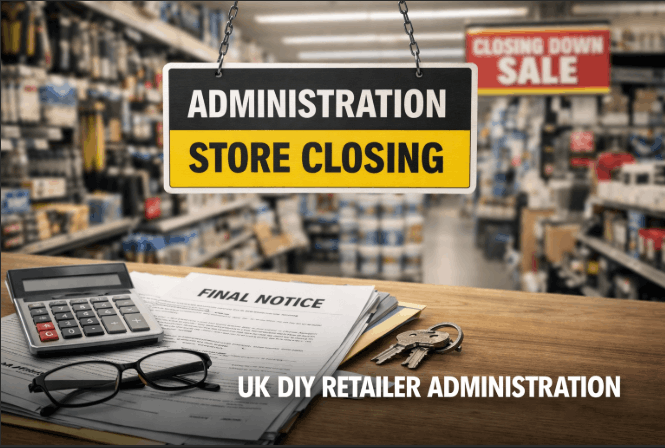
UK DIY retailer administration occurs when a home improvement chain can no longer meet its financial obligations and appoints licensed insolvency practitioners to manage its assets, protect creditors, and determine whether the business, or parts of it, can be sold as a viable operation.
The most recent case involved Homebase, which entered administration on 13 November 2024 owing £803 million.
Key Takeaways
- Homebase (trading as HHGL Limited and Hampden Group Limited) entered administration on 13 November 2024, with Teneo Financial Advisory appointed as joint administrator.
- CDS Superstores International, owner of The Range and Wilko, acquired 70 stores and the Homebase brand for £25.6 million in a pre-pack deal on the day of the appointment.
- Around 2,300 employees lost their jobs; dismissed workers could claim statutory redundancy pay, holiday pay, and arrears of wages through the Insolvency Service.
- Unsecured creditors submitted claims totalling £693 million, but only £800,000 was available through the prescribed part fund under the Enterprise Act 2002.
- Gift cards remained redeemable in-store immediately following administration; however, no new gift cards could be purchased or topped up from 13 November 2024.
Which UK DIY Retailer Went Into Administration and When?
Homebase, the UK home improvement and garden retailer, entered administration on 13 November 2024, making it the most significant UK DIY retailer administration since Focus DIY collapsed in 2011. The company traded under two legal entities: HHGL Limited and Hampden Group Limited.
Teneo Financial Advisory Limited was appointed as joint administrator, with Gavin Park, Gavin Maher, and Adele MacLeod named as the three joint administrators. At the point of appointment, Homebase operated 135 stores across the UK and employed 3,446 people.
The total debt stood at £803 million, a scale that left unsecured creditors with almost no realistic prospect of meaningful recovery.
Hilco Capital, which had owned Homebase since purchasing it for £1 in 2018, had been working with Teneo to explore cost-saving options before ultimately placing the business into administration.
The joint administrators completed the brand and store sale to CDS Superstores on the same day they were appointed, an unusually swift asset disposal even by pre-pack standards.
No UK DIY retailer has since emerged to compete with B&Q at national scale, leaving a market gap that the Homebase collapse made permanent.

Why Did Homebase Go Into Administration?
Homebase’s collapse was not the result of a single failure. It was the cumulative outcome of six compounding pressures, with the deepest roots in a foreign acquisition that destroyed roughly £1 billion of value between 2016 and 2018, eight years before the final administration.
The causes, ranked by causal weight:
- Wesfarmers’ failed Bunnings expansion (2016–2018): The Australian conglomerate bought Homebase for £340 million in 2016, stripped out its soft furnishings range, Homebase’s key differentiator from B&Q and attempted to replicate its Australian Bunnings hardware format in the UK. The experiment failed. Wesfarmers sold the business for £1 to restructuring firm Hilco Capital having lost approximately £1 billion on the venture.
- Structural damage from the Hilco CVA (2018): Hilco immediately implemented a company voluntary arrangement (CVA), closing 42 stores and cutting 1,500 jobs. The CVA stabilised the store estate, but Homebase never recovered the product range or customer footfall it lost during the Bunnings experiment.
- Freight and energy cost surge: Homebase’s own filings confirmed freight costs increased by over £40 million and energy bills by £10 million in the 2022–23 financial year costs that directly eroded already thin margins.
- Trading losses: The retailer posted an £84 million loss in the year to January 2023, with cost-of-living crisis conditions suppressing consumer confidence and discretionary spending on home improvement.
- Post-pandemic DIY sector decline: The DIY sector experienced a demand surge during the 2020–2021 lockdowns, followed by a sharp reversal as consumer spending shifted back to services and travel. Homebase was structurally exposed to this reversal.
- Online competition: Amazon, specialist online retailers, and direct-to-consumer brands steadily eroded Homebase’s product category dominance in tools, garden, and home furnishings, without the physical footprint costs that burdened Homebase.

What Does Retail Administration Actually Mean Under UK Law?
Administration is a formal insolvency procedure under the Insolvency Act 1986, designed to protect a company from immediate creditor action while licensed insolvency practitioners determine the most viable path forward, whether a sale, a restructuring, or a managed wind-down of operations.
Once administrators are appointed under the Insolvency Act 1986, a legal moratorium takes effect, no creditor can pursue debts, repossess stock, or enforce security without the administrator’s consent.
The administrator’s primary duty is to achieve the best outcome for creditors as a whole, not to preserve the brand or protect jobs, though both can result from a well-executed asset sale.
The five-step process under UK law:
- Company cannot meet its debt obligations: Directors resolve to seek administration; application made to court or by qualifying floating charge holder.
- Court appoints licensed insolvency practitioners: Administrators take full operational and legal control of the business immediately on appointment.
- Moratorium on creditor action: No creditor can pursue legal action, repossess assets, or enforce security without the administrator’s consent during the administration period.
- Asset sale or restructuring: The administrator sells the business, or its viable parts, to recover funds for creditors. A pre-pack administration, as used in the Homebase case, completes this sale on or before the appointment date.
- Administration closes: Once assets are distributed and the process is complete, the company is dissolved or exits into a restructured form.
What Do Creditors Actually Recover in a UK Retail Administration?
Unsecured creditors almost never recover meaningful sums in a large UK retail administration and the Homebase case illustrates precisely why. Despite 1,299 unsecured creditors filing claims totalling £693 million, only £800,000 was available for distribution through the prescribed part fund.
The prescribed part is a ringfenced portion of floating charge realisations reserved for unsecured creditors under Section 176A of the Enterprise Act 2002.
In a retail administration of Homebase’s scale, this fund is mathematically incapable of providing meaningful recovery against nine-figure claims.
| Creditor Type | Legal Priority | Homebase Example | Recovery Outcome |
|---|---|---|---|
| Secured creditors | First | Wells Fargo Capital £20.1m claim | Recovered in full |
| Preferential creditors | Second | Employees (arrears, holiday pay capped) | Partial, via Insolvency Service |
| Prescribed part fund | Ringfenced | Enterprise Act 2002, s.176A | £800,000 maximum available |
| Unsecured creditors | Last | Ark Finco £523m; HMRC £10.2m | Fractions of pence in the pound |
Small business suppliers consistently file creditor claims without first assessing the realistic probability of recovery, a costly oversight when the prescribed part fund is the only pool available.
Registering as an unsecured creditor with Teneo preserves the legal right to any distribution, but in a retail insolvency carrying £693 million in unsecured claims, the prescribed part fund of £800,000 is the only realistic source of recovery.
Accurate financial records become operationally critical when a major retail client enters administration, creditor registration with Teneo requires documented proof of debt, and outstanding VAT obligations to HMRC remain enforceable regardless of the administration.
The best small business accounting software can help track outstanding invoices, VAT, and creditor correspondence systematically during an extended administration period.

What Rights Do Employees Have When a UK Retailer Goes Into Administration?
Dismissed employees retain statutory protections under UK insolvency law, with the Insolvency Service processing redundancy claims directly on the government’s behalf. In the Homebase administration, approximately 2,300 employees ultimately filed claims totalling £938,000.
Dismissed employees can claim the following, subject to a weekly earnings cap of £700:
- Statutory redundancy pay: Calculated on length of service, age, and weekly pay (capped at £700 per week)
- Arrears of wages: Unpaid wages owed at the date of dismissal, capped at eight weeks
- Compensatory notice pay: Statutory notice that the employer failed to provide
- Holiday pay: Accrued but untaken annual leave owed at dismissal
- Protective award: Where 20 or more employees at a single site were dismissed without proper collective consultation under the Trade Union and Labour Relations (Consolidation) Act 1992; up to 90 days’ pay, with eight weeks recoverable from the government (up to £5,600 additional)
Of the 3,446 Homebase employees at risk on the administration date, those who transferred to CDS Superstores or Sainsbury’s retained continuous employment, the remainder were dismissed and became eligible to claim through the Insolvency Service.
A further group transferred when Sainsbury’s completed acquisitions of 11 stores. The Insolvency Service processed redundancy claims for those dismissed without a transfer.
What Happened to Gift Cards, Orders, and Refunds During the Homebase Administration?
Gift cards remained redeemable in Homebase stores immediately following the administration appointment on 13 November 2024, but no new gift cards could be purchased or topped up from that date. Teneo confirmed the gift card position publicly on 14 November 2024, the day after the administration appointment.
Existing orders, including kitchen, bathroom, and bedroom installations, were to be fulfilled subject to stock availability, with Teneo committing to issue refunds, including deposits, for any orders that could not proceed.
Customers seeking a return for unwanted goods purchased in-store faced a more restricted position: in-store returns for non-faulty items were suspended during the administration period.
Statutory consumer rights under the Consumer Rights Act 2015 remained enforceable throughout. Customers with faulty goods retained the right to request a repair, replacement, or refund regardless of the administration status.
Customers who paid by credit card for orders above £100 retained Section 75 of the Consumer Credit Act 1974 as an additional route for a full refund from their card provider, a protection that sits entirely outside the administration process and does not require creditor registration.
Customers unable to obtain a remedy through normal channels could register as unsecured creditors with Teneo. However, with £693 million in competing unsecured claims and only £800,000 available, meaningful recovery was not a realistic expectation.

What Happened to the UK DIY Market After Homebase’s Collapse?
CDS Superstores International, trading as The Range and Wilko, acquired 70 stores and the Homebase brand in a pre-pack deal for £25.6 million, completed on the same day as the administration appointment.
Around 1,150 Homebase employees transferred to CDS immediately; the deal represented one of the fastest significant asset disposals in any major UK retail administration during 2024.
B&Q, owned by Kingfisher plc, the dominant UK DIY market operator, acquired five former Homebase sites, with Wickes taking a further four. The remaining stores ceased trading by March 2025.
The Homebase brand continues to operate online under CDS ownership, positioned alongside The Range’s broader homeware offering.
B&Q now operates as the only national physical DIY retailer at scale in the UK, a level of market concentration last seen before Homebase was founded in 1979.
Independent DIY and garden retailers now compete in a market where B&Q and Wickes set the benchmark for customer experience, payment reliability included. Choosing the best card reader for small business is one practical step smaller operators can take to close that gap at the point of sale.
The Homebase administration is only the second collapse of a major UK national DIY chain, the first being Focus DIY in 2011, which saw B&Q and Wickes absorb the majority of its store estate.
Both major UK DIY retail collapses, Focus DIY in 2011 and Homebase in 2024, ended with Kingfisher plc absorbing store assets and strengthening B&Q’s market position. The outcome was not coincidental; it reflects B&Q’s financial capacity to acquire selectively during a competitor’s distress.

Conclusion
The Homebase administration, the largest UK DIY retailer collapse since Focus DIY in 2011, exposing the structural fragility of high-footprint retail in a market reshaped by online competition and cost inflation.
For employees, the Insolvency Service provided the primary route to statutory pay recovery. For unsecured creditors, recovery prospects were near-zero. UK DIY retailer administration means permanent market consolidation for consumers, suppliers, and the wider home improvement sector in 2024–2025.
FAQ
Is B&Q in danger of going into administration?
No. B&Q is owned by Kingfisher plc, a FTSE 100 group with diversified European retail operations and consistent annual revenues above £13 billion. The company has no publicly disclosed debt distress, no insolvency proceedings, and actively expanded its UK store estate following the Homebase collapse.
How many jobs did the Homebase administration affect?
Around 2,300 Homebase employees lost their jobs. Of the 3,446 employees at risk on 13 November 2024, approximately 1,150 transferred to CDS Superstores and a further group to Sainsbury’s. Dismissed employees filed redundancy claims totalling £938,000 through the Insolvency Service.
Can customers still use Homebase gift cards now?
Gift cards were accepted in-store during the active administration period. Since the majority of remaining stores closed by March 2025 and the brand now operates online under CDS Superstores, customers should contact CDS directly to confirm whether any remaining balance is still redeemable under the current online-only operation.
What is the difference between administration and liquidation in the UK?
Administration is a rescue-focused procedure under the Insolvency Act 1986 the administrator attempts to sell the business or its assets to repay creditors. Liquidation is terminal: a liquidator sells all remaining assets and the company is dissolved. Administration can lead to liquidation if no viable sale is achieved.
Will Homebase be replaced by another dedicated DIY retailer?
No direct national replacement has emerged. The UK DIY market is now effectively a two-operator market at a national scale, B&Q and Wickes, with The Range absorbing former Homebase stores under a broader homeware format. The physical retail gap Homebase left at the national scale remains unfilled.
Disclaimer: The information provided in this article is for informational purposes only and does not constitute formal financial, legal, or insolvency advice.