Best HR Software For Small Business in UK: Best Platforms Compared On Pricing And Compliance

The best HR platforms for small business in the UK are cloud-based HR management systems priced by headcount, built around UK payroll integration and statutory compliance tools such as HMRC reporting and pension auto-enrolment.
As of September 2026, Breathe HR, Sage HR, CharlieHR, BrightHR, Zelt, and Personio lead this market for UK businesses with 1–50 employees.
Key takeaways
- Breathe HR charges a flat £24 a month for 1–10 employees, the cheapest platform here on a per-business basis.
- CharlieHR stands out for early-stage teams by pairing its automated HR software with on-demand access to certified UK HR advisors.
- Statutory sick pay became a day-one right on 6 April 2026 under the Employment Rights Act 2025.
Best HR Platforms for Small Business in the UK (2026)
Six platforms stand out as the best HR software options for UK small businesses in 2026: Breathe HR, Sage HR, CharlieHR, BrightHR, Zelt, and Personio.
Each platform offers established UK compliance features, automated holiday tracking, and secure cloud employee databases tailored to small business operations.
The table below normalises pricing to a 1–10 employee headcount, the size band most UK micro-businesses fall into.
| Platform | Price (1–10 employees) | Best for |
|---|---|---|
| Breathe HR | Flat rate (from £24/month) | Micro-businesses replacing spreadsheets with simple core HR |
| Sage HR | Per employee (from ~£4.40/user/month) | Businesses running payroll and HR on the same system |
| CharlieHR | Flat team band (from £21/month) | Startups wanting HR software paired with real human advice |
| BrightHR | Bespoke quote (contract-based) | Shift-based teams needing rotas and health and safety tools |
| Zelt | Base fee + per-app modular pricing | Tech startups managing HR, payroll, and IT devices together |
| Personio | Bespoke quote (tier-based) | Growing SMEs with complex UK and EU compliance needs |
Note: Base pricing excludes VAT and is accurate at the time of writing. Final costs vary based on modules and contract terms. Check vendor websites for live rates.
Pricing models vary enough across these six platforms that a straight pound-for-pound comparison misunderstands the real cost.
Most HR software for SMEs targets exactly this headcount band, since it’s where spreadsheet-based HR starts breaking down. The breakdown below covers what each platform does well, where it falls short, and who it actually suits, starting with the cheapest.
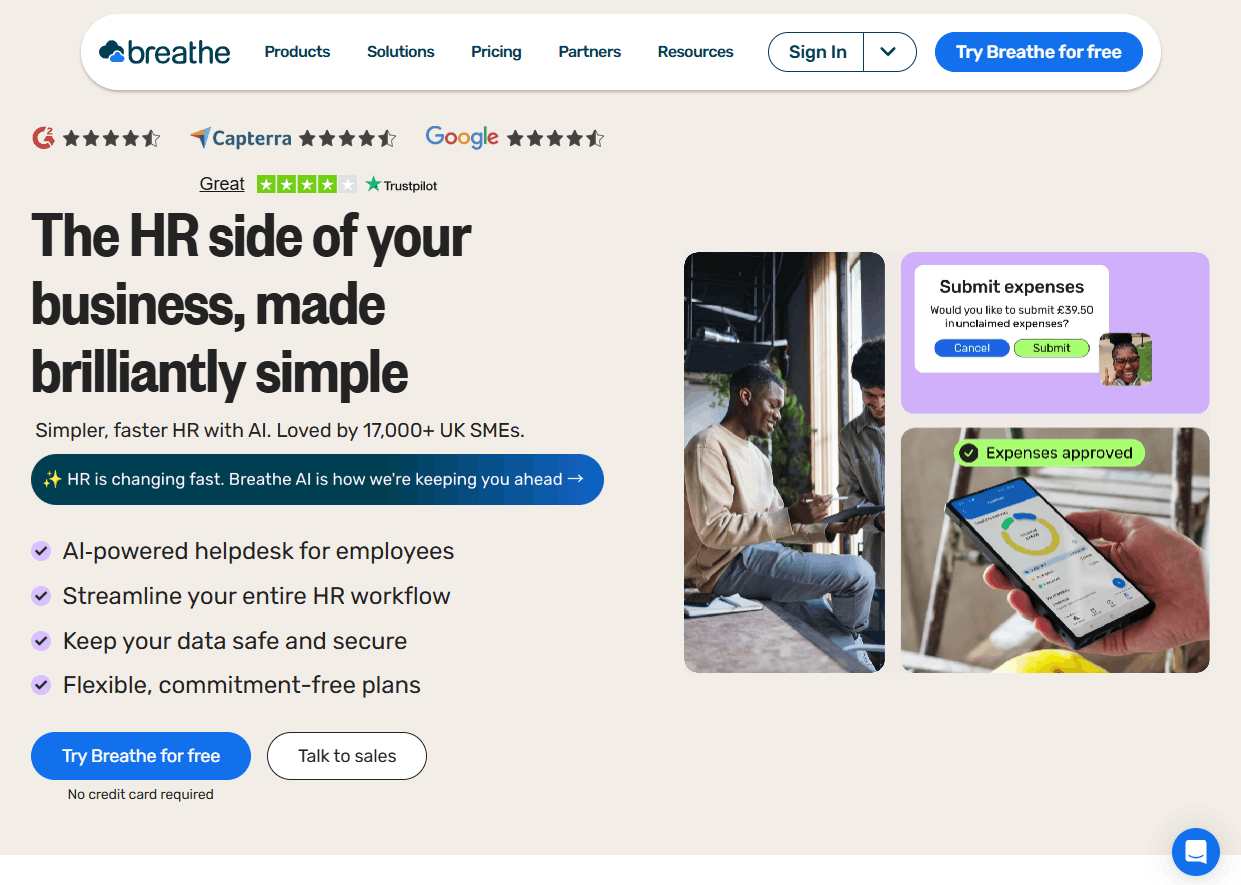
Breathe HR
Breathe HR is an established market leader for UK micro-businesses, built specifically to replace manual spreadsheets with straightforward core HR management.
Pros:
- Flat monthly pricing regardless of headcount within the 1–10 tier
- ISO 27001-certified data security
- UK-specific holiday and Bradford Factor absence tracking
Cons:
- No native payroll processing
- Reporting and third-party integrations are limited compared with larger suites
Best suited for: UK micro-businesses with 1–10 staff wanting simple, affordable core HR rather than a full HR suite.
Lesser-known factor: G2’s own comparison tool still lists Breathe’s entry-level price at £22 a month. Breathe HR’s live pricing page has since moved that figure to £24.
Sage HR
Sage HR stands out among small business HR platforms for its tight integration with Sage accounting and payroll ecosystems, allowing businesses to run workforce records and payroll in sync.
Pros:
- Direct integration with Sage’s own payroll software
- Modular structure, start with Core HR, add performance reviews or recruitment later
- Built-in shift scheduling and rota tools
Cons:
- Per-employee pricing scales cost up quickly as headcount grows
- Some users report a learning curve during initial setup
Best suited for: Businesses already running Sage accounting or payroll software.
Lesser-known factor: Sage HR began life as CakeHR, a London startup, before Sage Group acquired and rebranded it in 2019.
CharlieHR
CharlieHR is built specifically for small teams and founders operating without an in-house HR department, focusing on an intuitive user interface and human advisory support.
Pros:
- Includes access to a human HR advisor, not just software
- Perks marketplace offering discounts at over 30,000 brands, which pairs well alongside broader employee benefits like small business health insurance.
- Flat team-band pricing rather than per-employee charges
Cons:
- No payroll processing
- Fewer integrations than larger platforms
Best suited for: UK startups and small teams wanting HR software paired with real human advice.
Lesser-known factor: CharlieHR’s current standard price is £21 a month for 1–4 staff, £1 higher than the £20 figure several comparison sites still publish.
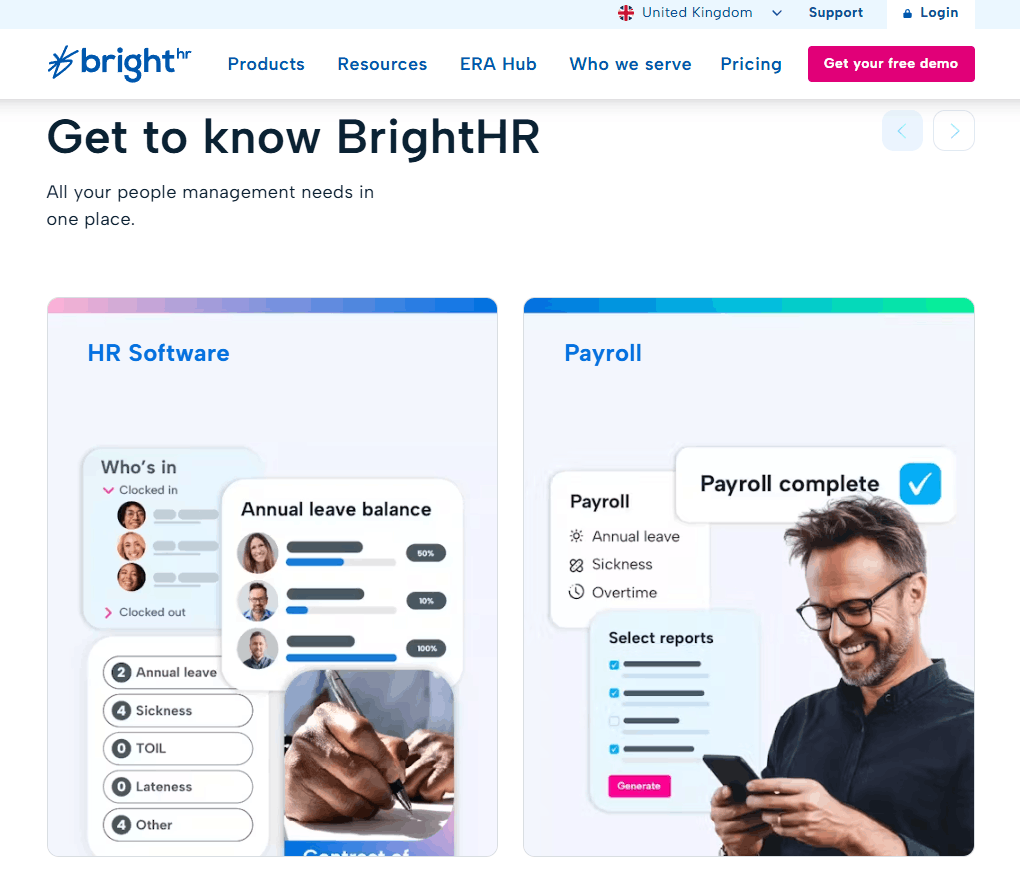
BrightHR
BrightHR provides extensive operational support for shift-based businesses, backing its rota and attendance software with 24/7 employment law and HR advisory services.
Pros:
- Built-in rota and shift scheduling for hourly teams, helping managers avoid accidental breaches of legal minimum rest periods between shifts.
- 24/7 employment law advice line via parent company Peninsula
- AI-powered “Bright BrAInbox” tool that answers HR questions instantly
Cons:
- Pricing isn’t published upfront, quotes are bespoke
- Some reviewers cite long contract terms and aggressive upselling
Best suited for: Shift-based teams in hospitality, retail, or care needing rota and health & safety tools alongside core HR.
Zelt
Zelt has become a prominent platform for modern UK tech companies and remote teams by combining HR records, IT hardware management, and HMRC-compliant payroll in a single system.
Pros:
-
Automates IT hardware provisioning alongside HR onboarding
-
Natively handles HMRC-recognized payroll without needing third-party integrations
-
Highly customizable workflows tailored to modern, remote-first companies
Cons:
-
Modular pricing (base fee plus per-employee fees for different apps) can get expensive
-
May be overly complex for traditional businesses that already have dedicated small business IT support and don’t need integrated device management.
Best suited for: UK tech startups and remote-first businesses that want to manage HR, payroll, and employee laptops from one dashboard.
Lesser-known factor: Zelt integrates directly with UK pension providers like Nest and Smart Pension, automating auto-enrolment compliance without manual data exports.
Personio
Personio is designed for growing UK SMEs with complex workforce needs, particularly businesses employing staff across both the UK and the European Union.
Pros:
-
Unmatched for managing cross-border compliance, holiday calculations, and multi-currency payroll integrations
-
Strong built-in applicant tracking system (ATS) for recruitment
-
Advanced custom reporting capabilities
Cons:
-
Often overkill (and overpriced) for micro-businesses operating solely within the UK
-
Pricing is completely bespoke, making budgeting difficult without a sales call
Best suited for: Growing UK businesses with 20+ employees, particularly those with remote workers across Europe requiring complex compliance handling.
Lesser-known factor: While headquartered in Munich, Personio has heavily localized its platform for the UK market, including seamless integration with UK standard right-to-work digital checks.
How Much Does HR Software Actually Cost?
HR software pricing for a UK small business typically runs between £20 and £45 a month at the smallest headcount tier, but the pricing model, not just the headline price, decides the real cost as a team grows.
Two pricing structures dominate this market:
- Flat per-business pricing (Breathe HR, CharlieHR): the whole team sits under one price band, so adding a ninth employee to a 1–10 tier costs nothing extra. The jump only comes at the next band.
- Per-employee pricing (Sage HR, BrightHR): every additional person adds a fixed charge. A 10-person team on Sage HR’s £4.40-per-employee rate pays roughly £44 a month, close to Breathe HR’s flat £24, but the gap widens fast past ten staff.
- The comparison mistake: businesses that compare a per-business quote against a per-employee quote without matching headcounts often assume one platform is cheaper than it actually is at their specific team size.
- Employment Allowance context: eligible small businesses can currently offset up to £10,500 a year against employer National Insurance, charged at 15% on earnings above the £5,000 secondary threshold. It doesn’t reduce HR software costs directly, but it belongs in the same budgeting conversation for businesses with 10 employees or more.
Software cost is just one element of your overall HR budget. Taking advantage of the free trial periods offered by most platforms here is the simplest way to test pricing fit and functionality before committing to a long-term contract.

Free HR Software for UK Small Businesses: What You Actually Get
Free HR software for UK small businesses typically means a capped, entry-level HRIS tier rather than a fully-featured system, and the cap usually applies to user numbers rather than core functionality.
Zoho People is the platform most often cited for a free tier, though sources disagree on the exact seat limit some put it at five users, others at ten.
That inconsistency is worth checking directly with the vendor before planning a team around it. Free tiers generally include basic employee records and leave requests but drop reporting, payroll integration, and priority support to paid plans.
For a genuinely small team, testing a paid platform’s free HR software trial often reveals more about long-term fit than a permanently free but feature-capped alternative, and none of the six platforms compared above requires a long-term commitment to try first.
What Features Should Small Business HR Software Have?
Small business HR software needs six core features to earn its monthly cost: centralised staff records, leave tracking, payroll integration, a self-service portal, onboarding tools, and performance review support.
- Centralised employee records: One searchable database for contracts, right-to-work documents, and personal details, replacing spreadsheets and email attachments for staff record management.
- Leave and absence tracking: Automated holiday booking, sickness logging, and tracking complex UK bank holiday entitlements, with a shared calendar so managers can spot overlapping requests.
- Payroll integration: A direct link to payroll software, avoiding manual re-entry every pay cycle; Sage HR and Breathe HR both connect via Sage or Xero.
- Employee self-service portal: Staff update their own details and request leave without emailing HR, often the single biggest time-saver small teams report.
- Onboarding software: Structured checklists for new starters, reducing the risk of missed right-to-work checks under UK GDPR and Information Commissioner’s Office (ICO) data-handling rules.
- Performance review software: Goal-setting and appraisal tools; even a basic version beats no structured review process at all.
Real Time Information (RTI) submission to HMRC should be a standard feature on any platform offering payroll integration, not an optional extra.
UK small business buyers should confirm RTI reporting is included before signing for HR software, since manual RTI filing outside the system defeats much of the point of paying for integration in the first place.
The IT groundwork underneath any cloud HR system secure logins, data backups, and granular access permissions is crucial for protecting sensitive employee data once records move off spreadsheets and onto a shared platform.
Staying UK Compliant: What HR Software Needs to Handle
UK HR software needs to track statutory sick pay, holiday entitlement, right-to-work checks (ideally by integrating with Home Office-certified Identity Service Providers), and pension auto-enrolment as legal minimums.
Because tracking sickness absences and fit notes involves “special category data” under UK GDPR, the platform must offer strict access permissions so line managers cannot view sensitive medical details meant only for HR.
Compliance failures carry real financial risk, and the rules are shifting through 2026.
HM Revenue & Customs (HMRC) requires accurate Real Time Information submissions every pay period, and the Advisory, Conciliation and Arbitration Service (ACAS) publishes the statutory codes of practice most disciplinary and grievance workflows rely on for UK employment law compliance.
What the Employment Rights Act 2025 changes
The Employment Rights Act 2025, which received Royal Assent in December 2025, made statutory sick pay payable from an employee’s first day of absence starting 6 April 2026, removing the previous three-day waiting period.
Crucially for micro-businesses, it also abolished the Lower Earnings Limit (LEL) for SSP, qualifying part-time and zero-hours workers for statutory sick pay.
Paternity leave and unpaid parental leave also became day-one rights from that date, replacing earlier length-of-service qualifying thresholds.
Payroll reporting and auto-enrolment basics
Auto-enrolment currently requires a minimum 3% employer pension contribution on qualifying earnings, on top of the employee’s own contribution.
HR software that tracks eligibility dates automatically reduces the risk of missing an auto-enrolment deadline, which employers must meet without being reminded by the regulator.
How to Choose the Right HR Platform for Your Business
Choosing the best HR system for small business needs comes down to three things, in order: headcount, compliance needs, then budget model.
- Confirm which headcount band applies now. Pricing tiers shift the value equation significantly, so check where a business sits before comparing quotes.
- List non-negotiable compliance features first. Statutory sick pay tracking and right-to-work document storage matter more early on than advanced analytics.
- Trial before committing to an annual contract. Most platforms in this comparison, including CharlieHR and Breathe HR, offer a free trial period of a week or more.
- Recheck pricing at every growth point. A platform that looked cheapest at five employees may not stay cheapest at fifteen, particularly under per-employee pricing.
Do:
- Match the pricing model to actual headcount, not just the headline price
- Shortlist platforms on compliance features before comparing extras
- Use a free trial before signing any annual contract
Don’t:
- Compare a per-business quote against a per-employee quote at face value
- Sign a long contract without checking cancellation terms first
- Assume a free tier covers payroll or detailed reporting
Businesses registered with The Pensions Regulator for auto-enrolment duties should confirm any new HR platform can log contribution dates automatically, since missed staging deadlines carry separate penalties from the HR software choice itself.
Formalising your HR processes often coincides with a broader hiring push, making it essential to choose a platform that scales smoothly as your headcount and compliance obligations grow.
Conclusion
Choosing the right HR software in the UK comes down to your current headcount, specific compliance needs, and preferred budget model, not just brand recognition.
Breathe HR and CharlieHR suit smaller teams prioritising flat monthly pricing, while Sage HR, BrightHR, Zelt, and Personio cater to businesses needing native payroll, shift scheduling, IT device management, or international compliance.
The best choice means matching a platform’s pricing structure and feature set directly to your team’s size and future growth plans.
FAQs
Is Zoho HR free?
Yes, Zoho People offers a free tier, though the exact user limit is disputed across sources, some cite five users, others ten. Businesses should confirm the current cap directly with Zoho before relying on it for a growing team.
What is the best free HR software for small businesses?
No platform in this comparison offers a fully-featured free tier long-term. Zoho People’s free plan is the most commonly cited option, though most UK small businesses outgrow free tiers once payroll integration becomes necessary.
How much does HR software cost for a 5-person small business?
For business owners comparing options for five-person teams, flat per-business pricing usually beats per-employee pricing at that headcount, Breathe HR’s flat £24 a month undercuts most per-employee alternatives below ten staff.
Do small businesses legally need HR software?
No, HR software isn’t a legal requirement in the UK. Businesses must still meet statutory obligations, sick pay, holiday entitlement, and pension auto-enrolment, with or without software, and manual tracking carries a higher risk of compliance errors.
Disclaimer: This article is for informational purposes only and does not constitute formal legal, tax, or employment advice; software pricing and statutory regulations are subject to change.